Close the Rabbit Hole
A critical intervention on the extraction of human attention
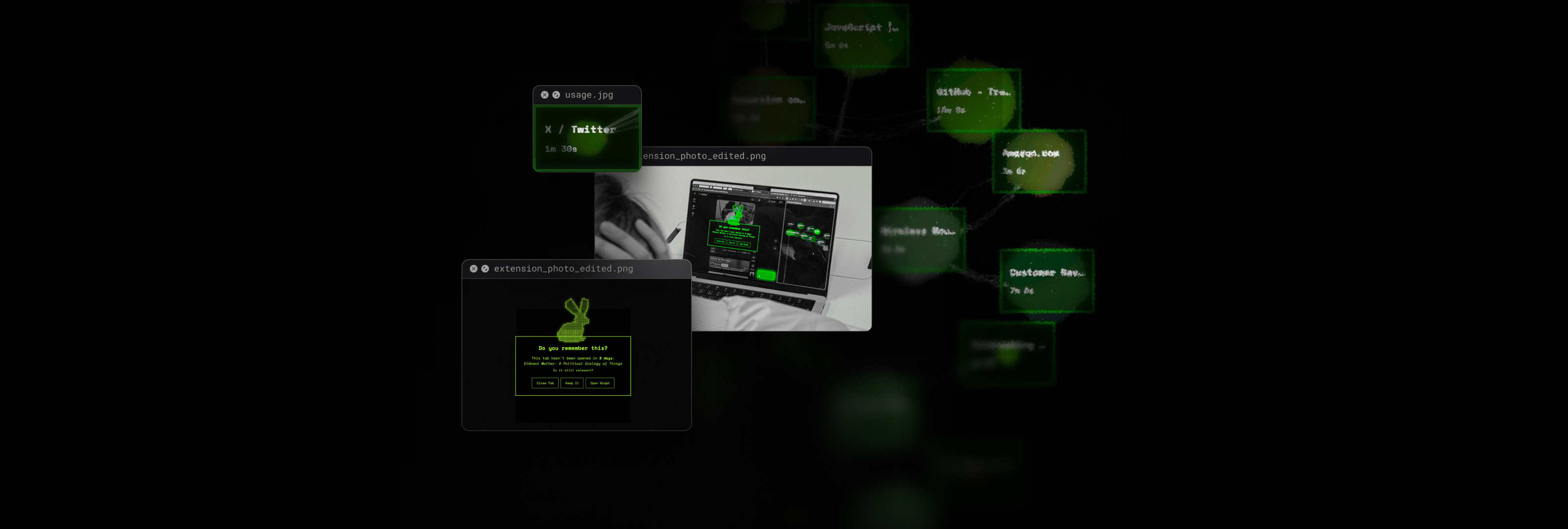
Close the Rabbit Hole (CTRH) is a browser extension that intervenes in the attention economy by reintroducing friction to the browsing experience.
The full report is available here!
arrow_outwardOverview
Contemporary platforms engineer environments of minimal friction and hyper-personalization to maximize time-on-screen1, removing the endpoints natural to other media that allow users to pause and reconsider. This creates the conditions for what researchers call "normative dissociation"2: a state of reduced self-awareness, self-control, and perception of time, which often conflicts with users' original intentions and leaves them with feelings of guilt and frustration3.
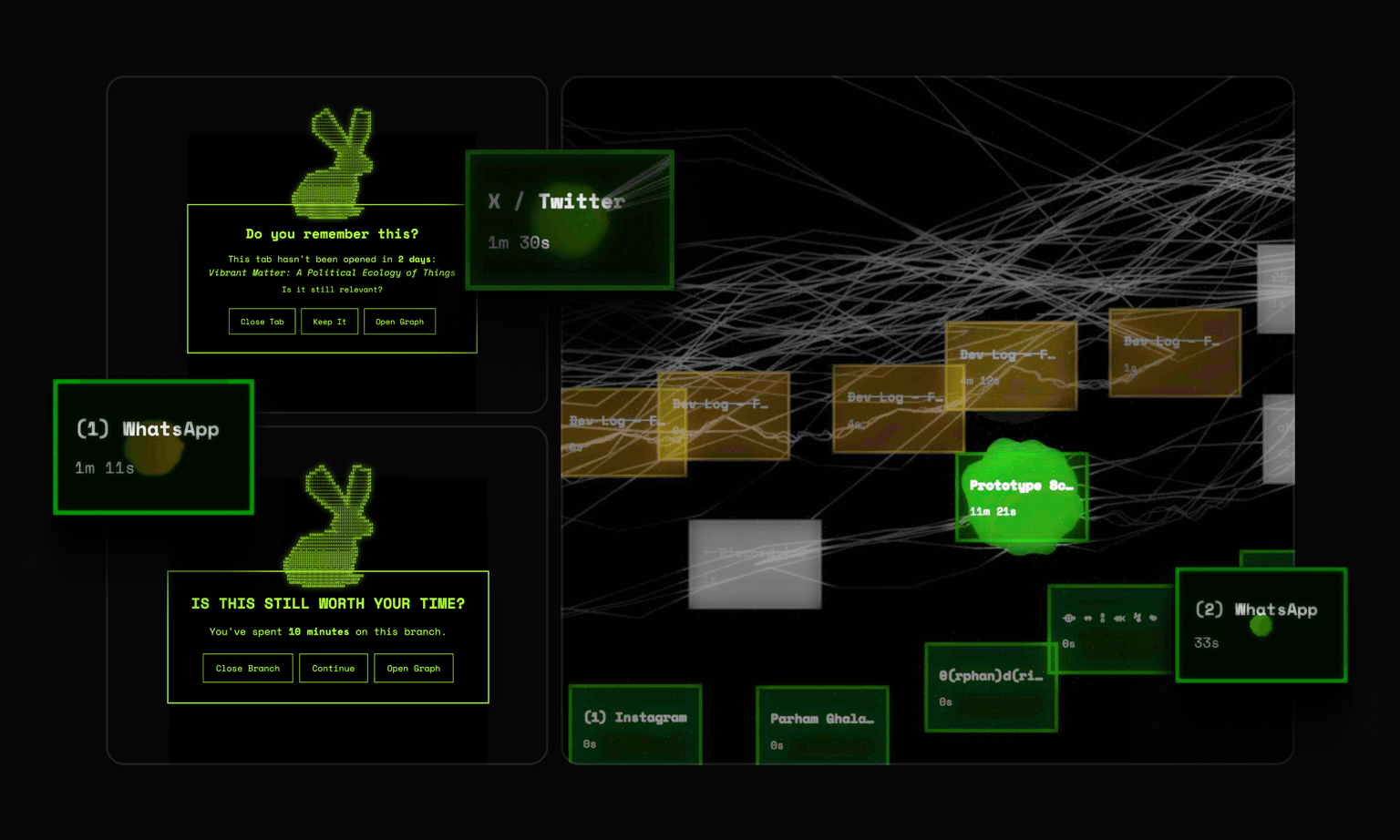
CTRH responds by creating deliberate moments where users can consciously evaluate whether to continue consuming content, aiming to restore a sense of agency and attention sovereignty4. Instead of blocking or punishing usage, the extension targets specific attention-extraction mechanisms with non-punitive counter-interventions2. It foregrounds time as a persistent, prominent signal to counteract the suppression of temporal awareness, and introduces occasional interruptive dialogues that act as cognitive breakpoints, "waking" users from altered states and inviting reflection.
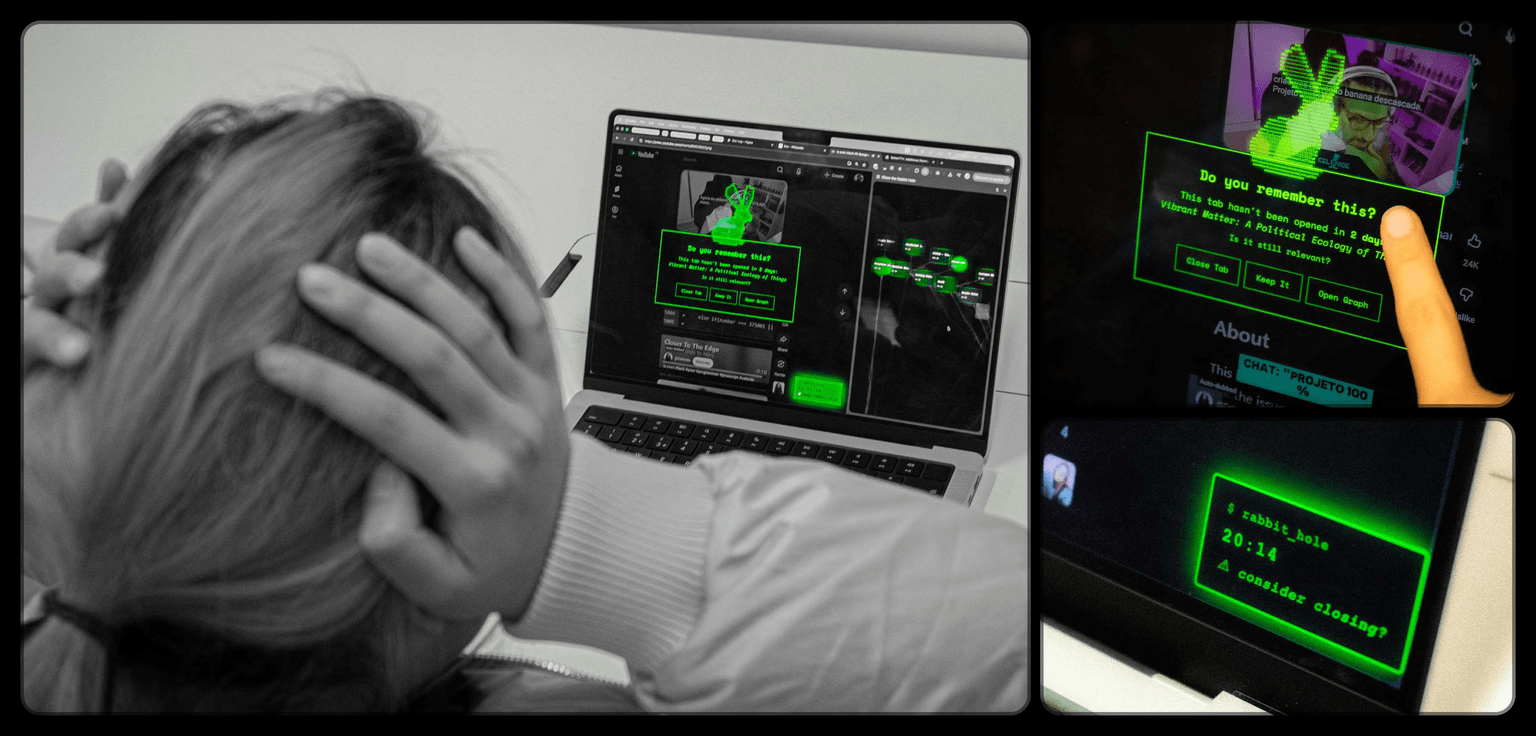
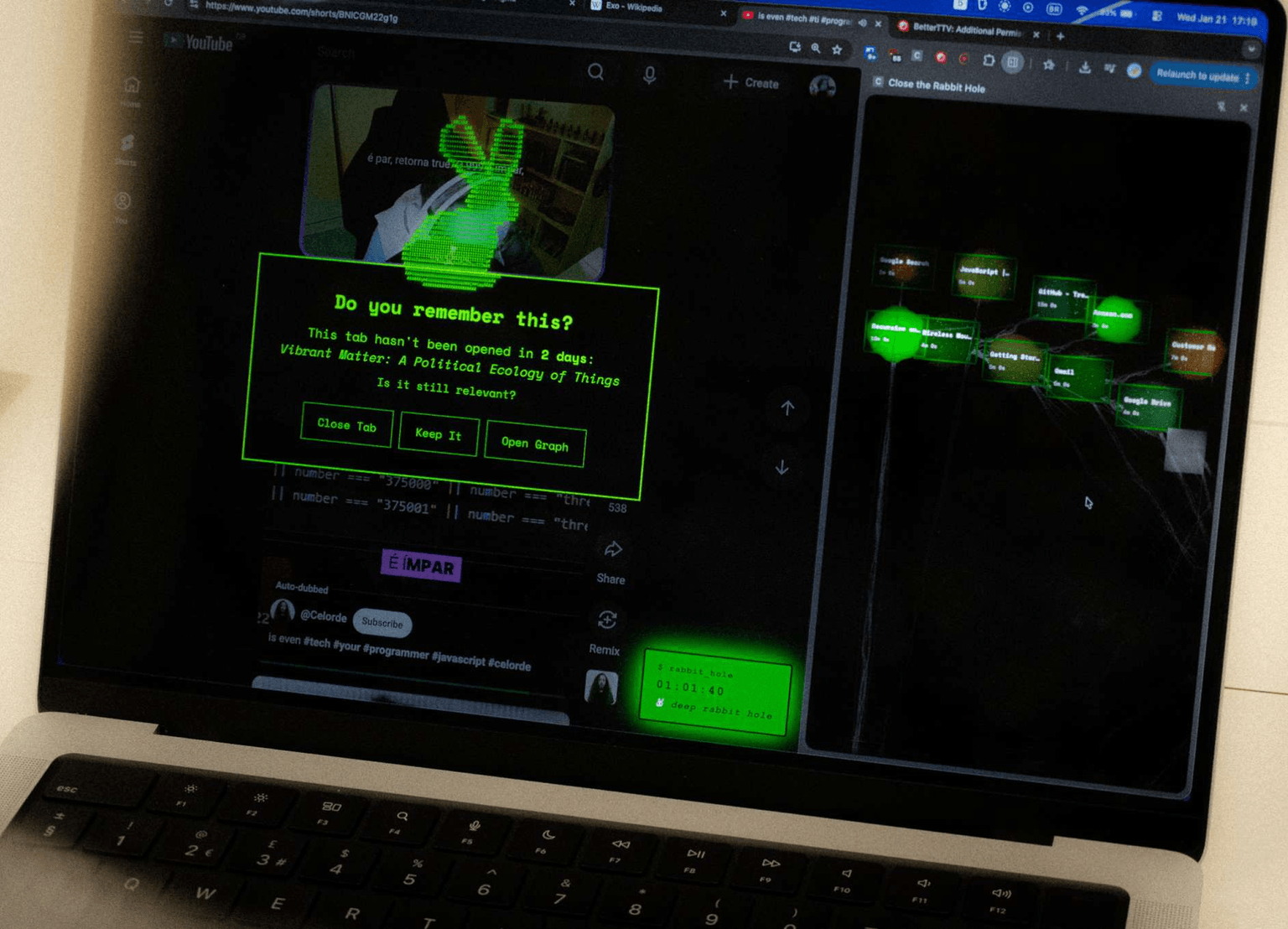
It also visualizes navigation as a growing, branching "rabbit hole," rendering the user's attention as a persistent structure they can see themselves building. Drawing on a retro-computing aesthetic of terminals, ASCII art, and CRT displays, CTRH explores how we might develop a symbiotic, rather than parasitic, relationship with content platforms.
References & Footnotes
Footnotes
- Matz, S.C., Kosinski, M., Nave, G. and Stillwell, D.J. (2017). Psychological targeting as an effective approach to digital mass persuasion. Proceedings of the National Academy of Sciences, online 114(48), pp.12714–12719. doi:https://doi.org/10.1073/pnas.1710966114 Accessed 20 January 2026. ↩
- Baughan, A., Zhang, M.R., Rao, R., Lukoff, K., Schaadhardt, A., Butler, L.D. and Hiniker, A. (2022). 'I Don't Even Remember What I Read': How Design Influences Dissociation on Social Media. CHI Conference on Human Factors in Computing Systems, pp.1–13. doi:https://doi.org/10.1145/3491102.3501899 Accessed 20 January 2026. ↩ ↩2
- de Segovia Vicente, D., Van Gaeveren, K., Murphy, S.L. and Vanden Abeele, M.M.P. (2023). Does mindless scrolling hamper well-being? Combining ESM and log-data to examine the link between mindless scrolling, goal conflict, guilt, and daily well-being. Journal of Computer-Mediated Communication, online 29(1), zmad056. doi:https://doi.org/10.1093/jcmc/zmad056 Accessed 20 January 2026. ↩
- Carpentier, C.L., Cheng, H.W.J., Jackobs, A., Roehrl, R., Klauer, P. and Doerfler, K. (2025). Attention Economy. UN Economist Network. United Nations. Available at: https://www.un.org/sites/un2.un.org/files/attention_economy_feb.pdf Accessed 20 January 2026. ↩