CTRL+Network
Renegotiating surveillance through network traffic
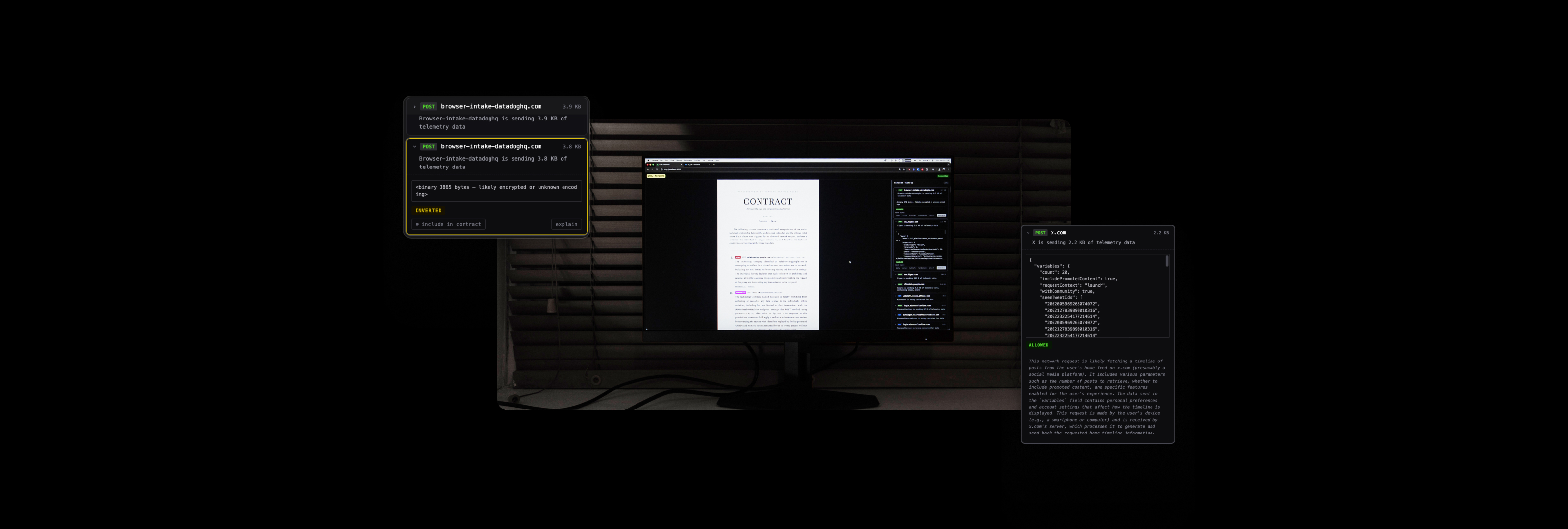
CTRL+Network is a piece of software for macOS and Linux that proxies a device's network traffic to use it as a space for learning and renegotiating our relationship with tech companies.
The full report is available here!
arrow_outwardOverview

The commoditisation of behavioural data underpins the contemporary digital economy, embedding surveillance into the infrastructure of everyday needs1. The relationship between an individual and the corporations operating these systems is fundamentally unbalanced: the terms of engagement are mainly set by the companies, leaving individuals little capacity to negotiate.
Drawing on Illich's concept of conviviality (tools that expand individual agency rather than producing dependency2), CTRL+Network treats personal computing's movement towards surveillance-driven, non-convivial systems as something that can be pushed back against through tools that offer individuals more transparency and control.
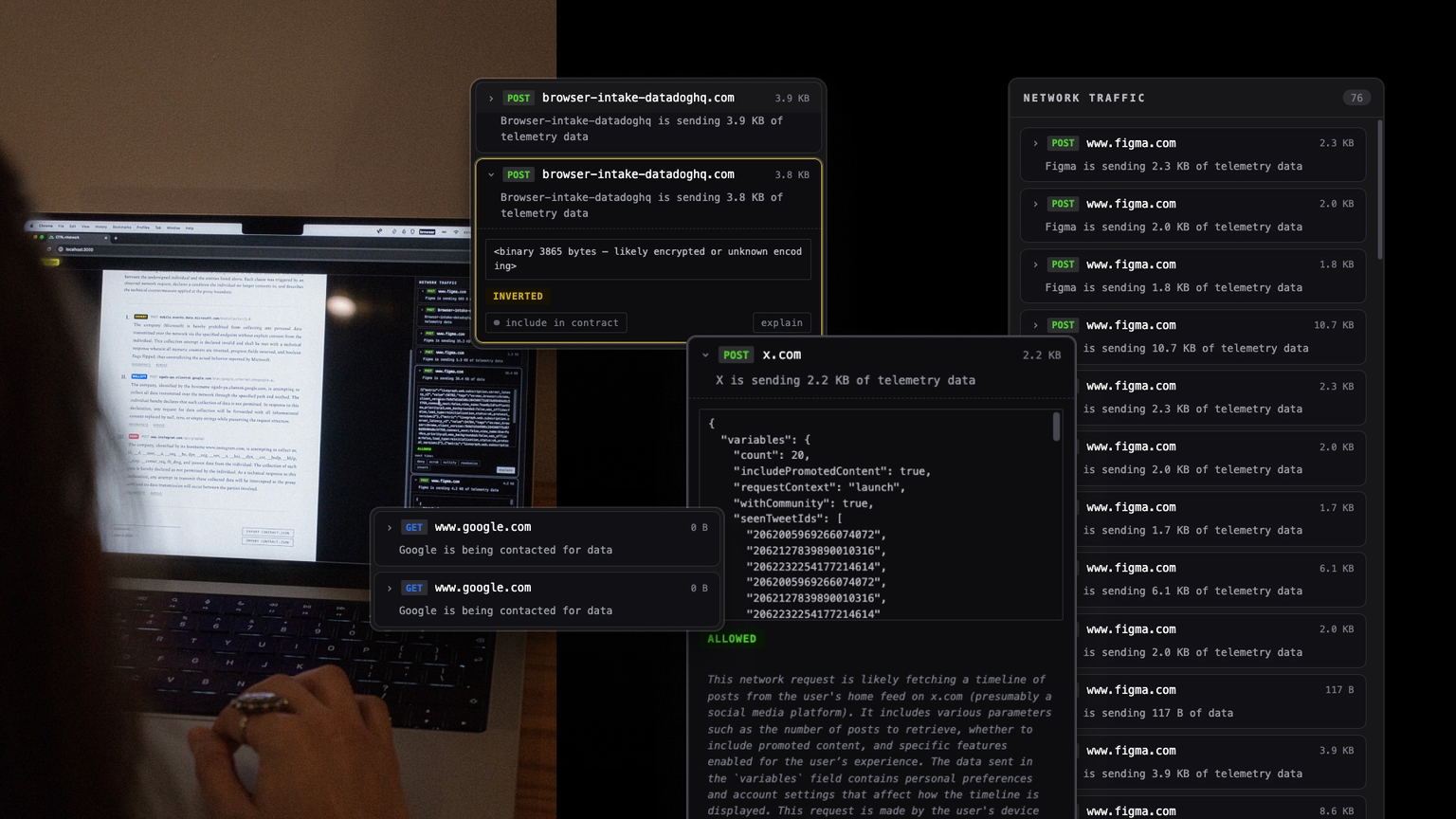
By sitting between the device and the network, the application performs an infrastructural inversion3, making requests that were designed to stay hidden a visible part of users' workspace. A local language model interprets this traffic in plain language. Once a request is legible, users can allow, block, fabricate, or poison it, drawing on Marichal's call to become an algorithmic problem and degrade the value of extracted data4.
Sitting within the tradition of critical engineering5 and critical technical practice6, CTRL+Network's intent is not to solve surveillance capitalism, but to explore how small, critically designed tools can shift our relationship with unfair systems. By opening a channel for negotiation, it creates a space where individuals, and potentially communities, can examine and rewrite the terms of a contract they never had the chance to understand.


Footnotes
- Zuboff, S. (2019) The age of surveillance capitalism: the fight for a human future at the new frontier of power. New York: PublicAffairs. ↩
- Illich, I. (1973) Tools for conviviality. London: Calder and Boyars. ↩
- Bowker, G.C. and Star, S.L. (1999) Sorting Things Out: Classification and Its Consequences. Cambridge, MA: MIT Press. ↩
- Marichal, J. (2025) You must become an algorithmic problem: renegotiating the socio-technical contract. Bristol University Press. ↩
- Oliver, J., Savičić, G. and Vasiliev, D. (2011) The Critical Engineering Manifesto. Available at: https://criticalengineering.org/ (Accessed: 29 April 2026). ↩
- Agre, P.E. (1997) ‘Toward a critical technical practice: Lessons learned in trying to reform AI’, in Bowker, G.C., Gasser, L., Star, S.L. and Turner, W. (eds.) Bridging the Great Divide: Social Science, Technical Systems, and Cooperative Work. Mahwah, NJ: Lawrence Erlbaum Associates. ↩